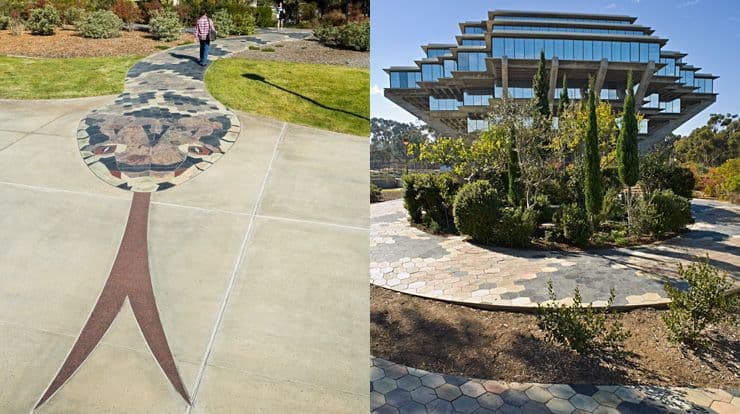
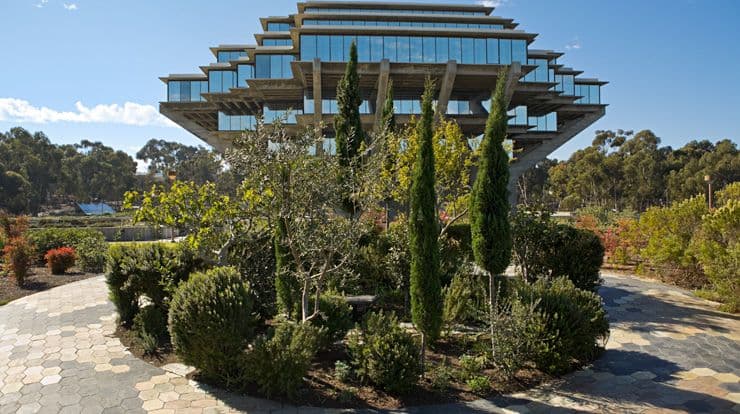
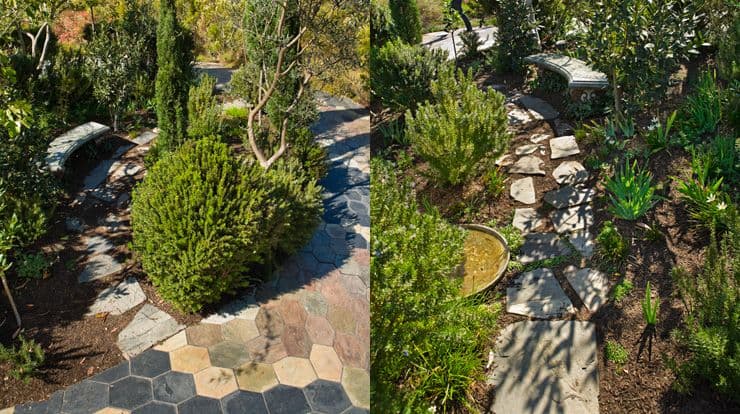
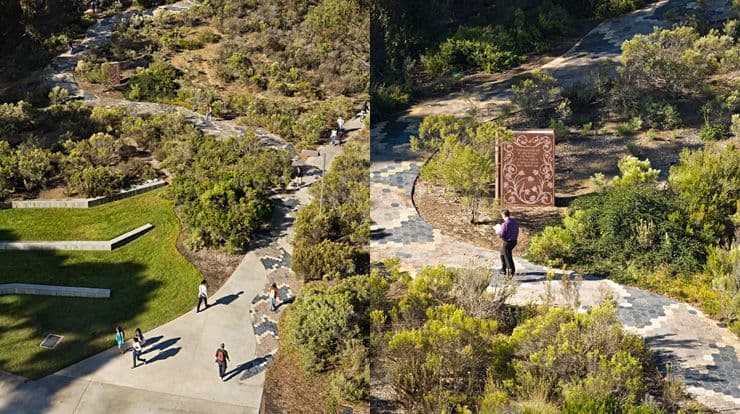
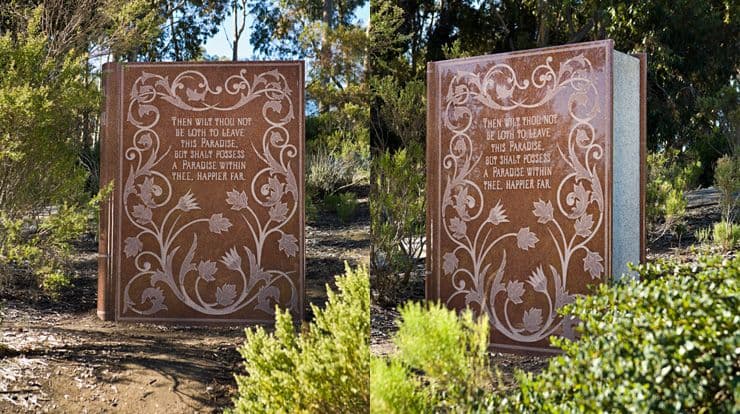
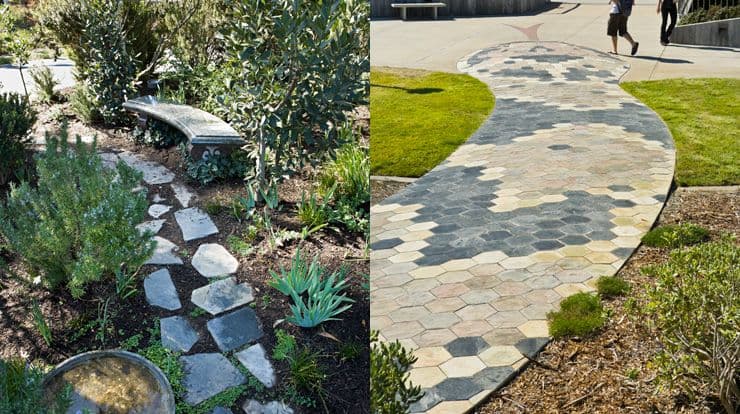
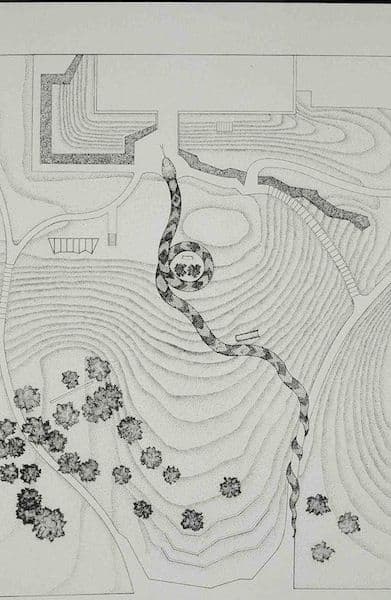
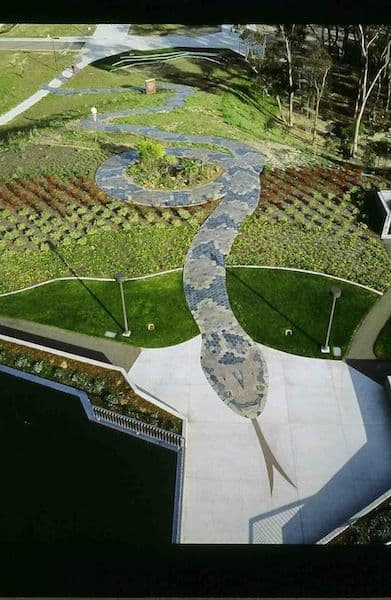
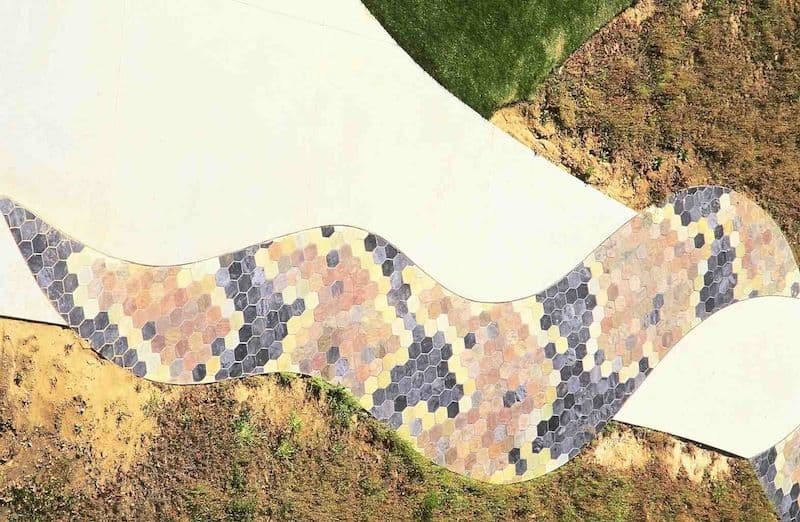
Smith's work for the Stuart Collection, Snake Path, consists of a winding 560-foot-long, 10-foot-wide footpath in the form of a serpent, whose individual scales are hexagonal pieces of colored slate, and whose head is inlaid in the approach to the Geisel Library. The tail wraps around an existing concrete pathway as a snake would wrap itself around a tree limb. Along the way, the serpent's slightly crowned body circles around a small "garden of Eden" with several fruit trees including an apple, a fig and a pomegranate. There is a marble bench with a quote from Thomas Gray: "Yet ah why should they know their fate / When sorrow never comes too late / And happiness too swiftly flies / Thought would destroy their Paradise / No more, where ignorance is bliss, tis folly to be wise." The path then passes a monumental granite book carved with a quote from Milton's *Paradise Lost*: "And wilt thou not be loathe to leave this Paradise, but shalt possess a Paradise within thee, happier far."
These pointed allusions to the biblical conflict between innocence and knowledge mark an apt symbolic path to the University's main repository of books. The concept of finding sanctuary within oneself — outside the idealistic and protected confines of the university — speaks directly to the student on the verge of entering the "real world."
Essay
Alexis Smith, Snake Path, 1992
Los Angeles artist Alexis Smith mines America's soul, our psyche and mythology. In the 1980s she was known for innovative collages combining fragments from popular culture—magazine covers, 1940s dust jackets, kitsch, and found objects—and playing on our imagination of the recent past, works that she collages into visual narratives. Like Joseph Cornell, she combs flea markets and thrift stores, collecting and organizing her myriad acquisitions into a library of objects in her studio from which she drew. She saw the potential for collage to make leaps in scale, and so she also painted large murals directly onto the wall, hanging smaller framed images over these painted backdrops and then also filling the room with objects, which effectively transformed architecture into a collage. In 1983, she transformed an entire two-story theatre lobby in Grand Rapids, Michigan, into a narrative drama using images derived from local history and the Art Deco style of the building, and later in the '80s she moved into the landscape, so it was not surprising that her name came up in a Stuart Collection Advisory Board meeting in 1986.
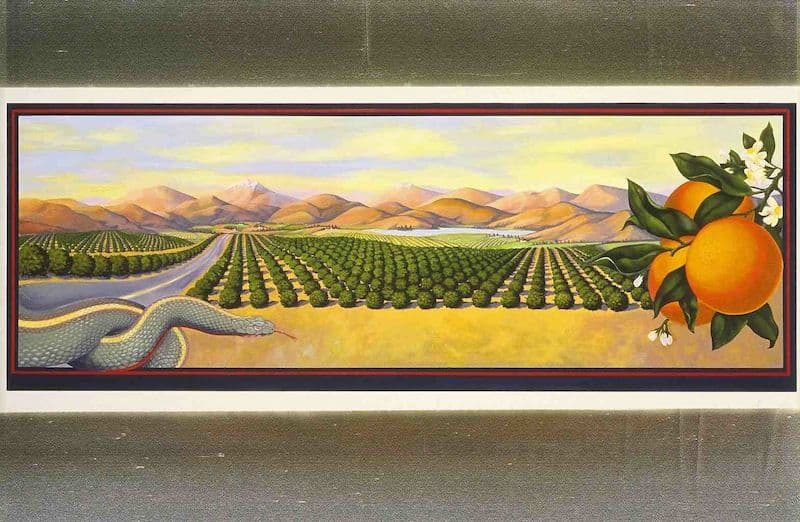
In April of that year, Alexis came to campus and we walked around together. At the time, she was winding up a series of works related to the idea of paradise with a huge sixty- by twenty-foot mural for the lobby of the Brooklyn Museum. This 1987 mural became part of the Stuart Collection in 2018, and it was the source inspiration for the work she proposed. It was painted in a style evoking old fruit crate labels and California postcards, depicting a vast orange grove with giant fruits and blooms receding into a purple-hued expanse of mountains. Running through the grove is a disturbingly vacant highway that metamorphoses in the foreground into a gigantic snake. This Eden is in trouble. Alexis thought a snake could be both a real path and a metaphoric one, leading to revelation, knowledge, and self-awareness—the tempting serpent of knowledge from the Garden of Eden. Like her immense mural, this idea could touch on myriad associations, from California as a paradise found, then lost, then perhaps found again, and on literature and knowledge as sanctuary.
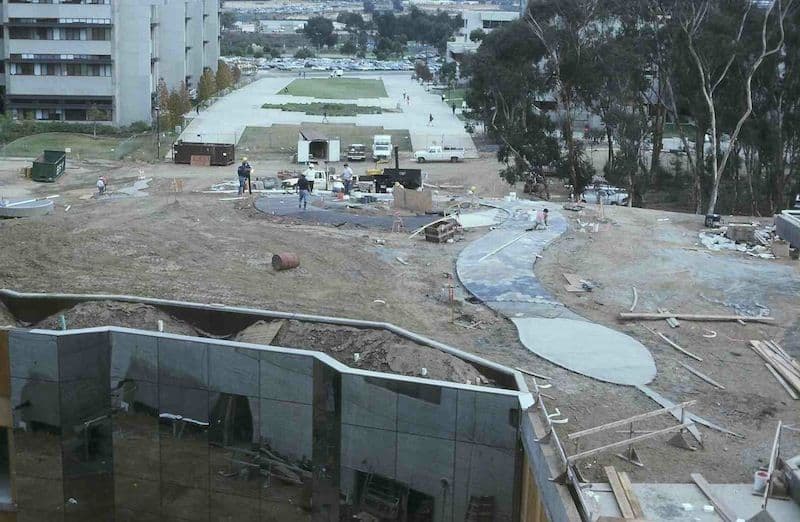
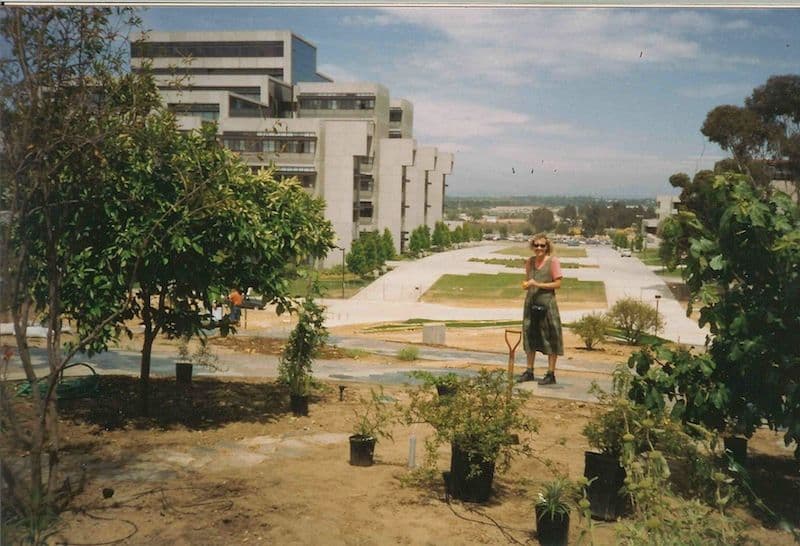
As it happened, the Central Library was about to undergo expansion and there was an architectural model of the building proposal on display in the lobby. Looking at the model, Alexis saw an opportunity. By January of 1988, she had made a wonderful preliminary drawing of a path in the shape of a snake, connecting the plaza to the west up a steep hill to the library terrace. At the base of the slope, the tail of the snake wrapped around a concrete path. It wound up the hill, passing a large granite book along the way, encircling a small garden at the top; and then the head, with tongue extended, almost touched the library terrace. The hillside itself had to be imagined, as it would not exist until the new library expansion project—an underground building—was completed.
We met with the library administration and the building committee who were enthusiastic. It was unusual for the Stuart Collection to meet with such excitement, but our timing was fortuitous, coinciding with the library expansion. UC San Diego agreed to let us prepare the contour plan for the hillside, and they agreed to underwrite the basic concrete substrate, the surrounding landscape, and utilities.
The plan was presented to the advisory board in January of 1989. Some members were ambivalent; foundation resources were running low and money was becoming a real concern. It was also felt that if the path weren't fully detailed and resolved, it could end up being quaint. Knowing Alexis, we assured them that there was no chance that any detail would be overlooked or that any compromise would be made; she has always been ferocious about perfect execution of her ideas, and fearless in her willingness and ability to apply the magic of collage to the scale of architecture and landscape. While she had never worked on something like this, she had what it took. After a lengthy discussion they agreed to go ahead.
As we went forward, and thanks to a major exhibit organized by Richard Armstrong at the Whitney Museum that traveled to LAMOCA, as well as a focus show at UC San Diego, both of which included drawings of the *Snake Path*, enthusiasm for the project grew. But the cost estimates also went up. In March of 1991, Mary wrote to the board that *Snake Path* had taken on a life of its own and "was coming along beautifully…we just haven't figured out how we will pay for it all." It is not unusual to arrive at a crisis of confidence during the process of commissioning a work. As often happens in projects of this scale, there comes a point when you just have to get going, with or without the full commitment of monies, and expect that the momentum will bring in the rest of the funding. Before we completely despaired, Jim DeSilva agreed that we should proceed and came through with additional funds.
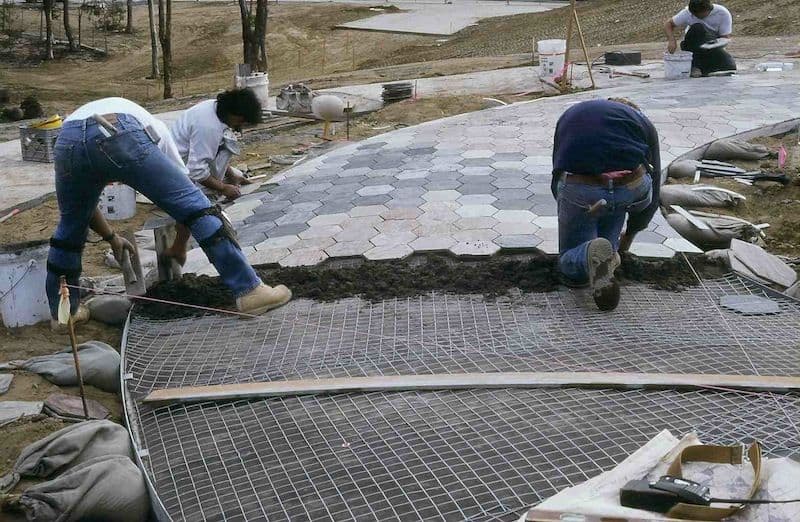
After contract negotiations we retained the Klaser Tile Company, whose expertise was central to the quality of the work, because this was not a project that could be solved in the studio or on the drawing board. But two things critical to its success had been solved. One was—how can a pathway, which normally is flat across and banked into a slope, feel like the body of a giant snake? The obvious answer was to make it rounded, and while this violated normal practice, it actually provided for areas that felt more stable as you walk up. You just have to pay attention to where you are in relation to the shifting slope, which, in turn, increases one's awareness of the rounded back of it. Another problem was how does one make a tiling that feels like scales, and is not only directional, but can also shift directions with the snake? Alexis came up with a solution for that one by finding references (just as she did with her collage narratives)—in this case, looking through books about mathematical tilings. An elongated certain hexagon will both tile and shift direction in sixty-degree increments, ideal for the undulations of the snake. So one has a sense of roundness as well as directionality, and enhancing this were three types of natural slate (from China, Africa, and India) that Alexis painstakingly laid out, in three sizes, in the approximate pattern of a rattlesnake. When laid out across the hillside, the snake as designed proved too long and circuitous, and so Alexis cut forty feet out of the length. When Klaser began the work of laying the multicolored slate tiles (wearing T-shirts they had printed saying "Team Snake"), they were able to make continued adjustments in the field, and the work seemed to grow organically. Big and small decisions were made every day, consistent with Alexis's maxim that the more care is given to detail, the more everything "belongs."
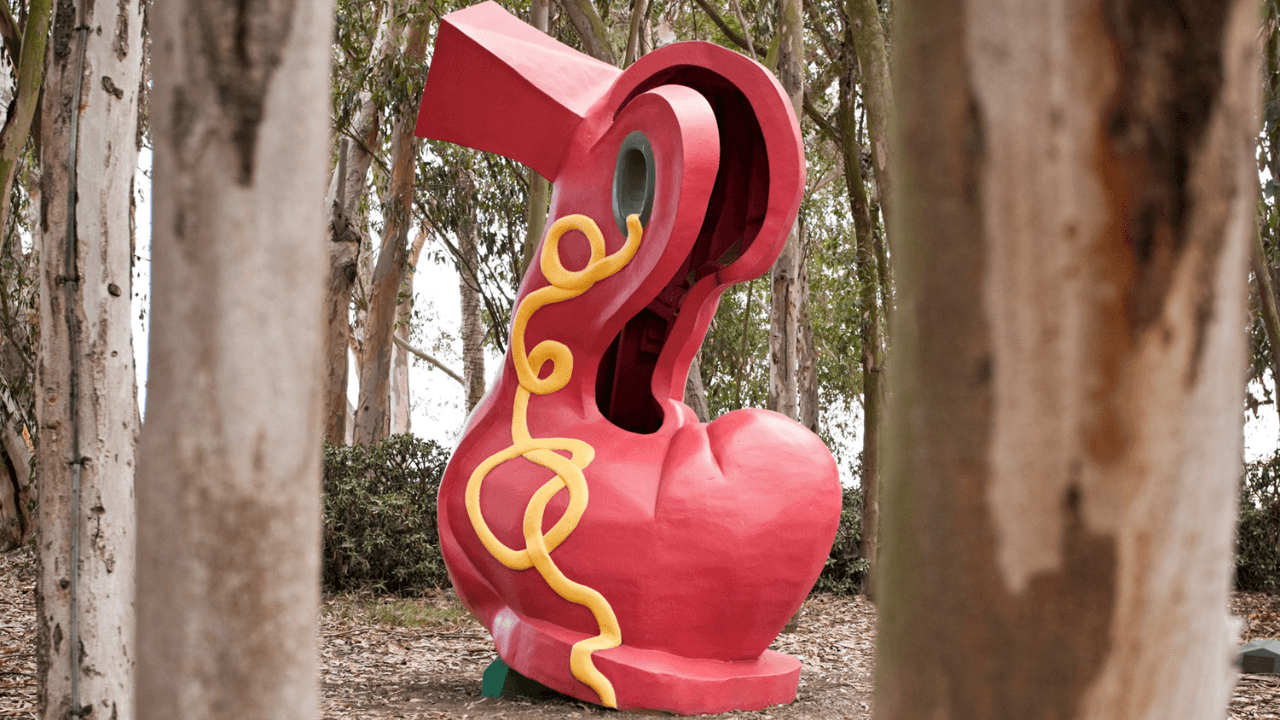
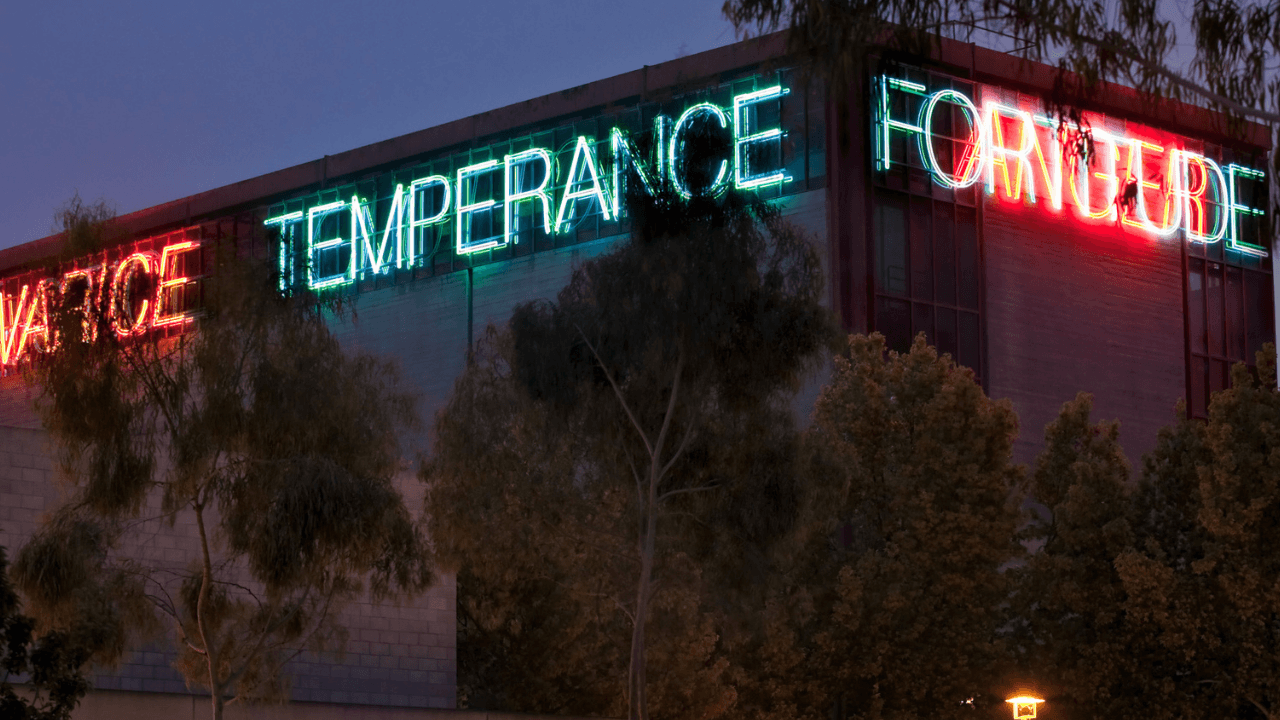
Jim DeSilva and others saw *Snake Path* as a turning point in the collection's history. It established a scale, integration, and critical mass. It became possible to see the path as celebrating the library and learning; the project made a leap in relating the collection directly to the university. The academic community easily grasped the work's literary references, and also linked it to Bruce Nauman's *Vices and Virtues*, which is visible from the snake at night. And students make these connections, too, on a very personal level, seeing intimations of morality, desire, strengths and failings, and the sense of home—most evident in *Fallen Star* by Do Ho Suh, which now hovers overhead opposite the Nauman—and of losing that memory, and finding it again.
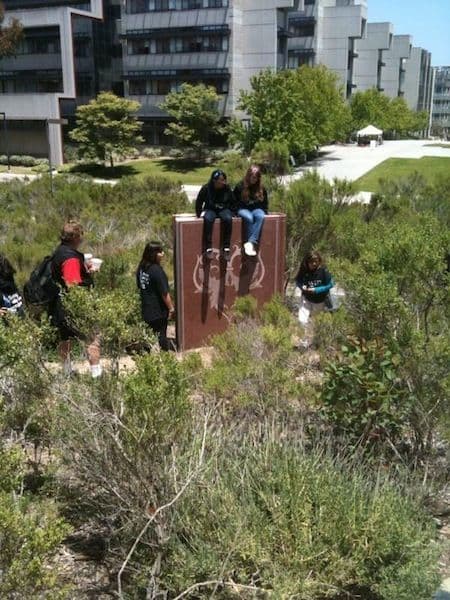
The Garden of Eden, squeezed in the grip of the giant snake, is a miniature landscape including a pomegranate (etymologically a seedy kind of apple, a *pomme grenade*), a fig tree, palms, and an apple tree. A reminder of innocence and bliss appears on a granite garden bench, on top of which is engraved a quotation from Thomas Gray's poem "Ode on a Distant Prospect of Eton College": "Yet ah! Why should they know their fate / Since sorrow never comes too late, / And happiness too swiftly flies. / Thought would destroy their paradise / No more, where ignorance is bliss, / 'Tis folly to be wise."
The quote is bordered by period etching of Adam and Eve in the garden on one side and a snake on the other. Looking east from the garden out over the canyons toward the distant mountains, with the huge spaceship-like library looming behind, this feels like a small island in the arid vastness of southern California.
The book was the last element to be added to this grand scenario, but it is the first to be encountered on one's pilgrim's progress up to the library. It is inscribed with Art Deco designs taken from a copy of Milton's *Paradise Lost*. It also has the correct library call number on the spine, just in case a visitor on the way to the library might want to read more than the quote on the front: "Then wilt thou not be loth to leave this Paradise, but shalt possess a Paradise within thee, happier far."
The first touchstone one encounters on the way up the path, the book sets up the metaphor of the university as a paradise from which students will eventually be cast forth, to find—or make—a paradise of their own. Alexis has taken a cultural myth and given it new meaning by casting it into the real world of physical materiality and experience.
This work is all about the physical experience of walking it: it feels so different from the usual flat path. The pattern, colors, and sheen of the slate are snakelike, and the way the path slopes with and against the hillside makes it unlike any other path. The hill is planted with native species like the natural canyons beyond that weave into the campus here. Alexis wanted it to be as if the snake had come up out of the canyon, where rattlesnakes actually live, and so the wildness of nature and the presence of culture are brought together.
It had been six years since we started on this journey when the work opened in October 1992. Alexis gave a lecture about her *Snake Path* experience, sharing great insight and a lot of acerbic asides. Afterward, a few of us were able to go up in a helicopter to get an aerial view of *Snake Path*. Alexis exclaimed, "Why, it looks just like the drawing." For a brief moment we were back at the beginning.
Share