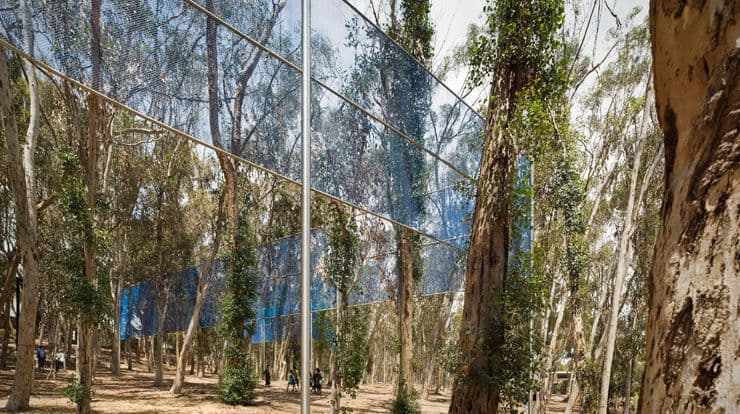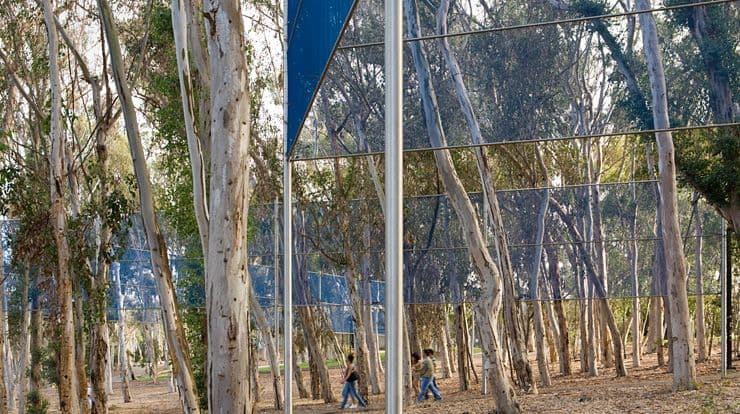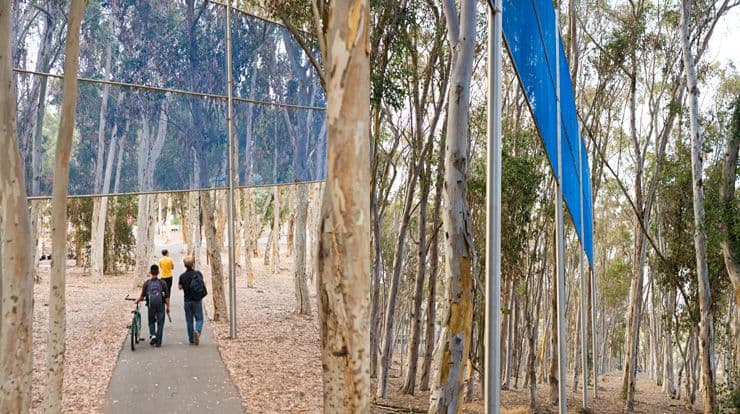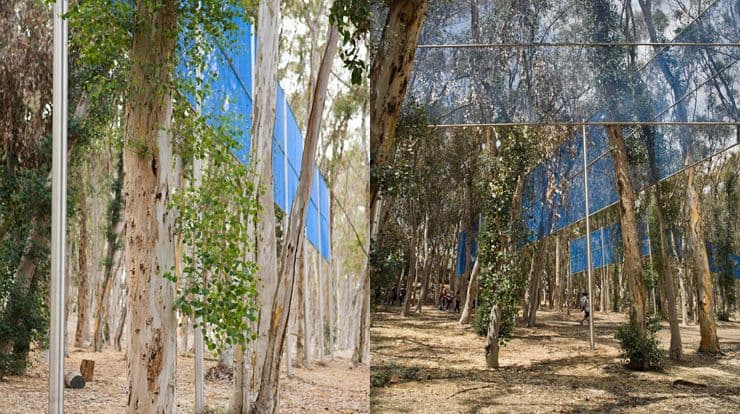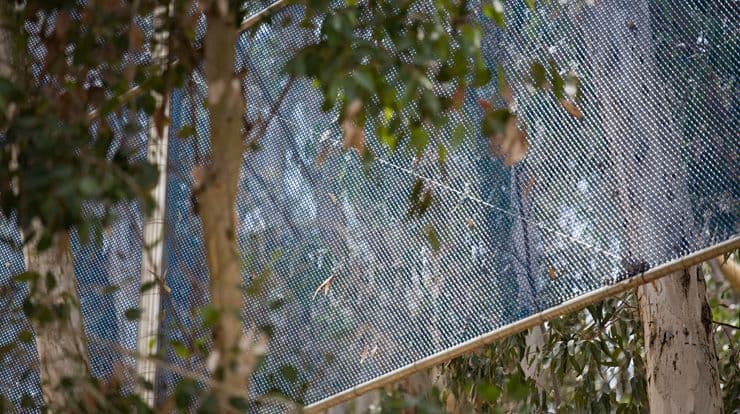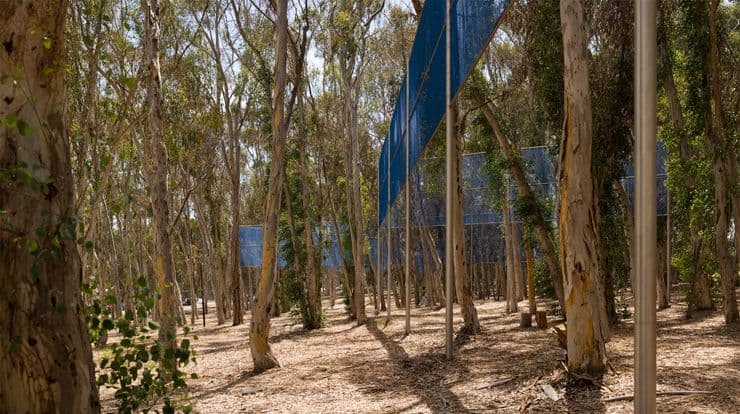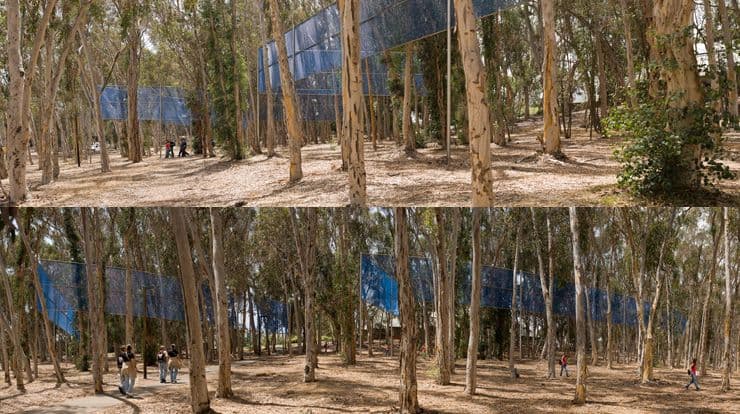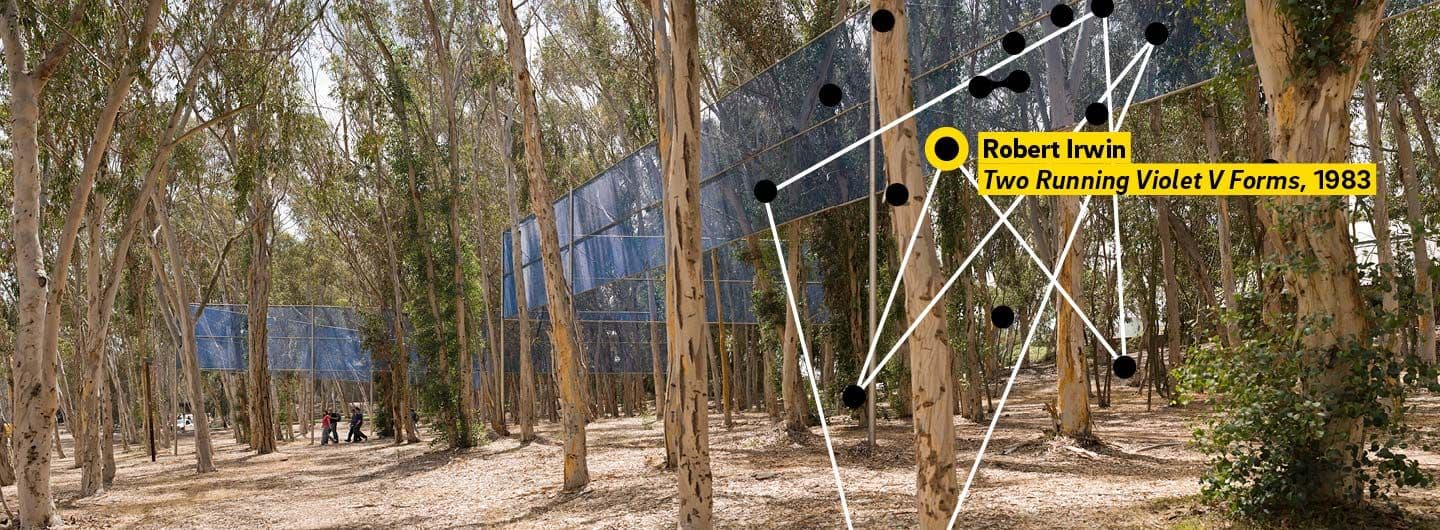
For his contribution to the Stuart Collection, Two Running Violet V Forms (his first significant installation in California) Irwin was drawn to the eucalyptus groves so characteristic of the campus. The contradiction inherent in this manmade forest appealed to him; the geometric regularity of the grid of trees is balanced by the infinite variety of light and detail that the natural setting nevertheless provides. Irwin installed two fencelike structures in V-forms amidst the trees. The "fences" are blue-violet, plastic-coated, small gauge chain-link fencing supported by stainless steel poles that average twenty-five feet in height. The structure maintains a constant elevation as the hillside terrain drops gently beneath it. A sprinkling of purple flowering ice plant, echoing but not matching the color of the chain link, is planted under the fence.
At no point is the fence an obstacle; rather it acts as a screen reflecting the changes in light throughout the day and the year, the moment and the season. Its gentle introduction of industrialized geometry recalls the unnatural grid that organized the grove, and suggests a sensual intrusion into the forest. For people who walk the grove's various paths, Irwin's sculpture provides an ever-changing perceptual experience - sometimes dramatic, and sometimes so modest it seems to disappear.
Essay
Robert Irwin, Two Running Violet V Forms, 1983
The Stuart Collection Advisory Board held Robert Irwin in high esteem, and from day one his work seemed the perfect choice to follow Niki de Saint Phalle's *Sun God. We wanted to demonstrate right away the wide range of possibilities for commissioned work using the campus as a canvas. Although Bob had won a number of commissions, for a variety of reasons none had come to fruition. He had never built a permanent work in his home state. (This was notable since, in 1984, he was to become one of the first artists to receive a MacArthur Fellowship, the so-called "genius award.") Yet Bob is the quintessential California artist. Born and raised in Los Angeles, growing up immersed in car culture and swing dancing, he made an early decision to be a painter. But his interest in both the act and the results of painting waned; and as it did, his fascination with everything going on outside the picture frame grew. Compelled by inquiry on the nature of perception, light, and space, he began to address place. Moving away from the realm of the object, he began taking the viewer—and himself—into new territory.
Bob first visited the UC San Diego campus in November 1981, a month after I arrived as director. He was immediately enthusiastic about the possibilities. Bob is an energized presence, a friendly, forceful personality. At the Portland Center for the Visual Arts, he had created one of his transforming scrim installations, visually and perceptually extending a 5,000-square-foot gallery space with very few gestures. I was excited about working with him again, and especially interested in what he might do in this new context.
Bob went right to work exploring the campus, sensing it as territory and watching the way people moved through it. He responded particularly to the many eucalyptus groves scattered around, and to the relief they offered from the more corporate aspects of the campus landscaping. Their shade, their fresh aroma, their play of light and shadow, and their soft color all appealed to him greatly, as did their geometric arrangement. They are a dominant feature of the campus, giving it a sense of place unique among the ten University of California campuses.
By 1981, the university was launching a period of serious expansion, and to make room for new buildings some of the eucalyptus groves were being cleared. Somewhat later the destruction of these groves became an issue, but Bob noticed it early on. He envisioned a work that would be a catalyst for thinking about the sensory qualities of the space and the light in the groves, and that would invite people to experience these places. This in turn, he felt, would propel both their appreciation of the groves and their awareness of their own powers of perception—an enduring Irwin subject.
Bob chose a centrally located grove with several major pathways running through it, a natural place to engage people walking through in their daily course of activity—trafficked in the minutes between classes, with a surge of students and faculty making their way along them hourly. Just as quickly, the paths become quiet again. Irwin liked the fact that people traversed the grove when they weren't necessarily thinking about art, encountering the place in an informal way.
In January 1982, Bob presented a proposal to the members of the advisory board who lived nearby and could gather on the grove site: Jim DeSilva, Patrick Ledden, Newton Harrison, and me. He planned a high fence of small-gauge, blue-plastic-coated chain link stretched between five-inch-diameter stainless steel poles with a brushed finish, the height of the poles varying with the slope of the hill to keep the fence level. The fence would be installed in two separate lengths, each in the shape of a V. Not designed to keep anybody out, it would begin a minimum of nearly nine feet above the ground, obstructing no one's passage. Below it would be planted a scattering of ice plant, which flowers in lavender blue.
The review group's considerable enthusiasm led to a telephone canvas of other members of the board, and the proposal was approved. Bob's energy and attention were then entirely focused on the project. He engaged Jack Brogan, a master technician and friend, to handle engineering and construction. Bad weather and late shipments of steel from Korea caused delays, but in time eleven-foot-deep holes were drilled and filled with concrete and rebar as supports for the poles. Not a single eucalyptus branch was damaged during construction, and the installation was completed by November—that is, the first version was.
This was not a work that could be assembled and built in the studio, then assessed and adjusted before installation. In late 1982 Bob called Jim DeSilva, Pat Ledden, and me to meet again at the site. Feeling that the pair of V forms felt too much like two separate works, one on each side of the path, he had decided he wanted to extend each section by about fifty feet—one across the path, the other farther into the grove. Although the work looked fantastic as it was, we agreed that the additional lengths would take it to a new dimension, substantially intensifying the experience and further integrating the work with its context.
We were committed to realizing the artist's concept and making the work as good as it could possibly be. My only concern was that extending the fence over the path might tempt someone to swing from the bottom horizontal bar, about nine feet above the path; but we went ahead anyway, and it has never been a problem. Right after the entire work was installed but before the opening, the fence stared sagging badly because of the distance between the poles. Jack Brogan designed a solution using sail-rigging-type wire stays, which have held up without even minor modification. Told that it would be impossible to grow anything beneath the eucalyptus trees because of the eucalyptus oil, we installed a watering system and went ahead with the plantings of purple-flowering ice plant. It still blooms from January until about April, becoming part of the ever-changing scenario in the grove.
*Two Running Violet V Forms* was completed and celebrated at an opening in May of 1983. Some months later a notable intervention occurred on the site of another campus eucalyptus grove—which, without any public warning, was cleared for the construction of new buildings. All that remained was a field of perhaps 100 stumps about eighteen inches high. Responding immediately, students made visible their concern: the next morning, each stump had a white Styrofoam cross set upright on it, suggesting a ghostly cemetery. The statement was short-lived but moving.
Bob's work is man-made of industrial materials. It is juxtaposed with nature and it gently integrates itself with the grove. Here, humanity and nature coexist, not competing, not dominating one another, each playing off the other. The fence is anything but static—it is a living, breathing part of the grove. It does not announce itself as art, but exists, sometimes waiting quietly to be noticed, sometimes softly saying, "Look at me." As visual experience, it is abstract, but underplays connections to any pre-existing body of knowledge one might have.
The piece has no formal beginning or end, but walking on the path that passes under it allows perfect entry into the experience. As one walks and looks, the blue changes, whether dramatically or softly. The open mesh of the chain link can appear opaque at moments or in stretches and transparent at others. As one looks up, the shadow of foliage plays on the blue in the sunshine. One sees branches through it and around it. Sometimes it seems that a ribbon of sky has been woven through the grove. It sparkles after a rain, becomes poetic and mysterious in fog, and on a bright day it can be positively operatic. In February and March, monarch butterflies flutter about from their brief winter-nesting spots in the closest trees. We think the color attracts them. The poles are in scale with the trees, and gray like their bark. As one walks through the grove, they appear and disappear in the trees, just the way people do.
The response has been mixed from the start. The work has been mistaken for scientific apparatus or for athletic equipment. Bob is pleased by all this, and the university is well served by the dialogue, conversation, and even classroom assignments generated by its presence.
Every artistic decision in this work is based on qualities that preexist and continue to exist. The place has stayed the same, but now, season to season, day to day, moment to moment, a heightened awareness of light, birds, flowers a cloud, a shadow, a breeze, all participate in—and contribute to—the pleasure, beauty, and awakening one can find here.
Folklore
The UCSD students have many legends about this sculpture. Some are even told as truth at freshman orientations or to gullible librarians willing to put them in print:
The winter before the sculpture was constructed was very stormy and windy. When the students came back after spring break to see the sculpture, they thought it was put up to keep the trees from falling down.
Another rumor had it that some giraffes escaped from the San Diego zoo. It seems (according to the same rumor) that giraffes really like eucalyptus leaves. The fences were put up to help capture the giraffes so they could be returned to the zoo. Even today, if you ask someone what the fences are, you might get "giraffe catcher" as an answer.
Or they might tell you it's a volleyball net for giants.
Share