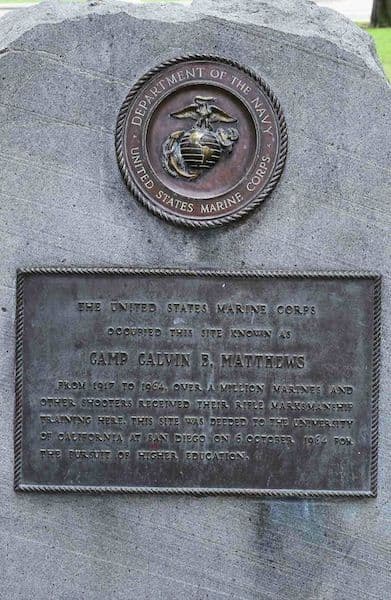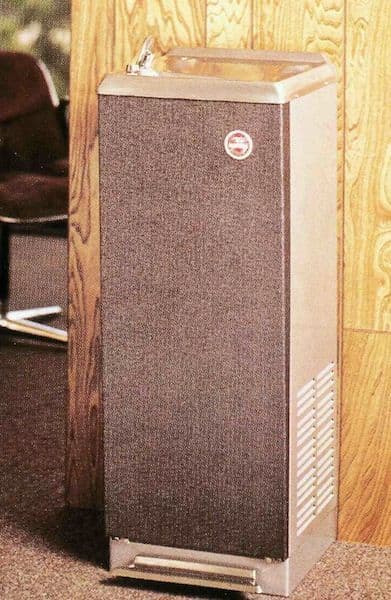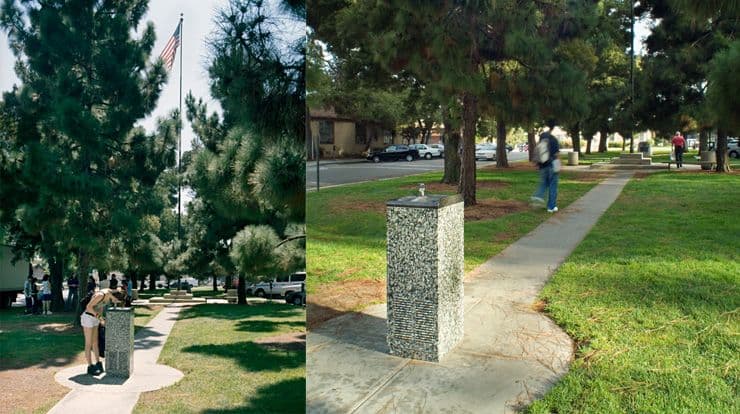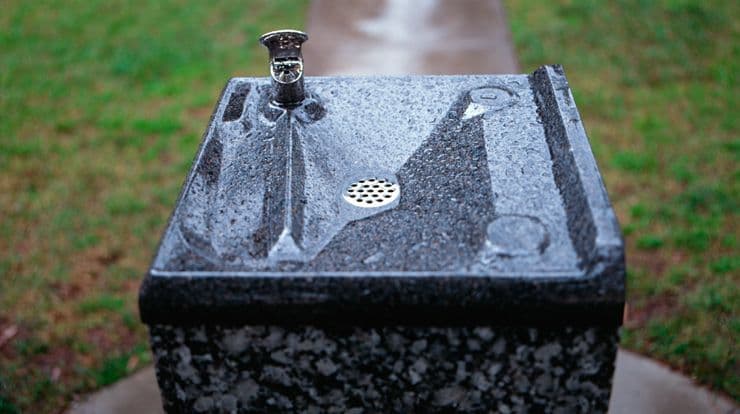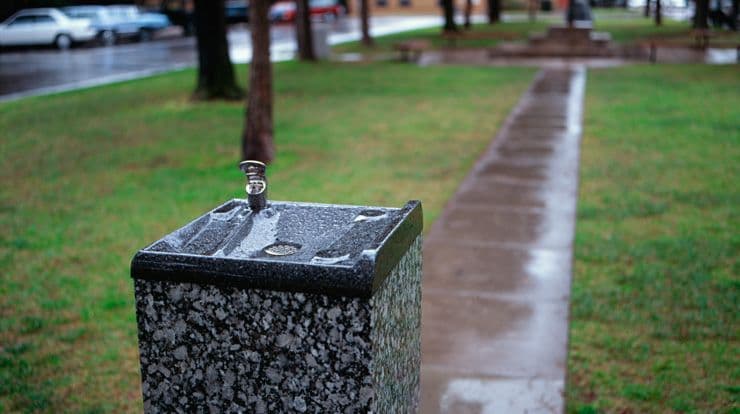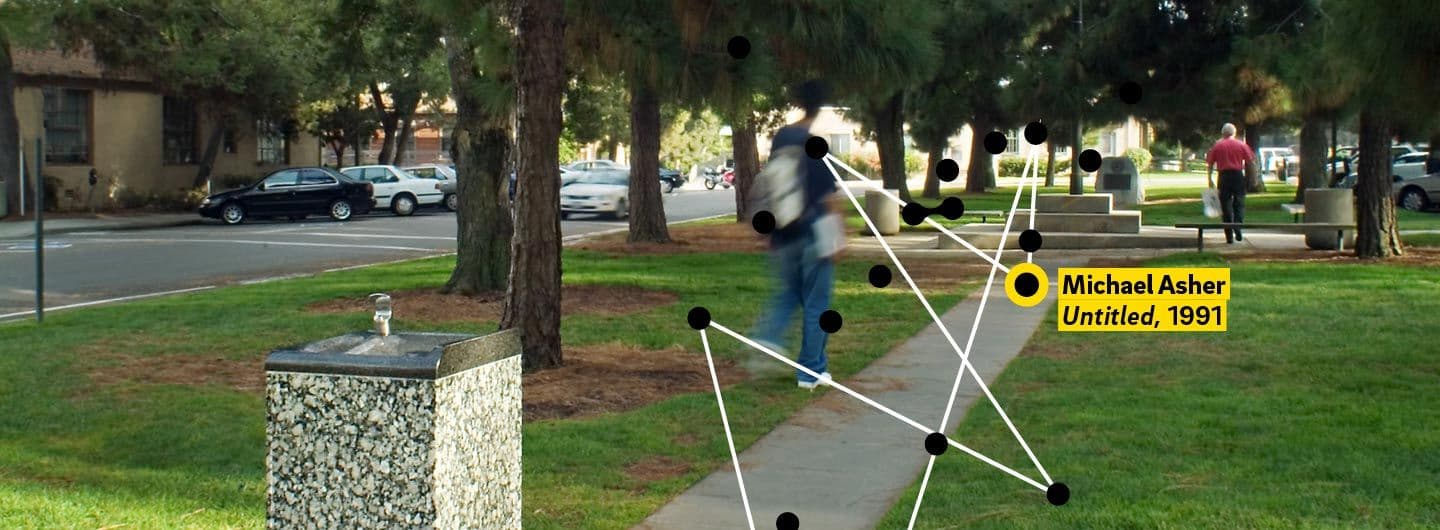
Although Asher was a seminal figure in Los Angeles and has been widely recognized in Europe, his untitled project for the Stuart Collection is his only permanent public outdoor work in the United States. This functional, polished, granite drinking fountain is an exact replica in granite of commercial metal fountains typically found in schools, business offices and government buildings. Instead of its usual context as interior office furniture, the fountain is placed monument-like on a grass island in the center of Town Square next to the university administration offices and the Price Center. The siting of his work is fundamental to its meaning; it is counter posed with a tall American flag and a granite marker commemorating Camp Matthews, a World War II training center and artillery and rifle range which occupied the land on which UCSD now stands.
Asher's work projects several cultural references into one modest object, and it is a play on sculpture's historic role as representation. When one leans down to drink from the fountain and looks west, the flagpole serves as a line to a rock with a plaque denoting the history of this place. As an ironically monumentalized fragment of any banal administrative environment, the drinking fountain mirrors the nearby monument to Camp Matthews, suggesting both contradiction and continuity between the institutions of defense and of learning, of the military and the university. The fountain, in its modesty and its reversal of the traditional grandeur of water fountains as public monuments, also calls to mind Southern California's need to manage and preserve its natural resources in light of the ongoing water crisis caused by large-scale agricultural and urban development.
Essay
Michael Asher, Untitled, 1991
For Michael Asher, context is all. His work comments on function and often-invisible systems. One of the leading conceptual artists, based in Los Angeles but showing mostly in Europe, he points to architecture and institutional procedures or systems that influence our understanding of things without our necessarily being particularly aware of them. His work is fused with and comments on its setting, sensitizing us to its history. The UC San Diego campus, with its beginnings as a military training ground, seemed a perfect place for him to explore and consider. Although highly recognized and often commissioned for exhibition projects, he had no permanent public work in this country, which was surprising given the recent focus on place, history, and dependence on site. He was high on the Stuart Collection Advisory Board's list and responded enthusiastically when we called.
Michael first visited the university in 1984. On an extensive tour, two things sparked his interest: the campus signage, which was in great need of clarity; and the possibility of turning a small yellow-brick building near the Gilman entrance into a visitors' information center. The building, once an electrical switching station, was unused and neglected. Upon reflection and inquiry, Michael decided that the size and complexity of the campus signage made it a less attractive challenge. He abandoned that pursuit. His interest in graphics, however, became an opportunity: in addition to developing a project, he wanted to redesign the Stuart Collection's stationery—an unusual and typically subversive idea. We use a version of his design to this day.
In the meantime the yellow-brick building was slated for destruction to make way for the new Cellular and Molecular Medicine Facility—development winning out over history. He did not give up, and returned many times over the next four years. Of all the artists who have been commissioned, Michael spent the most time by far exploring, researching, analyzing, and understanding the physical and historic campus. He considered and thought through many interventions. On an extended visit in 1988 he focused in on a site near the chancellor's office that he felt could be essential to an understanding of the university as both a place and an institution existing within a history.
This area is a median strip about 300 feet long and 55 feet wide, a grassy island surrounded by a parking loop. In the center is a high flagpole that flies the American flag and, on the south end, a stone landmark, placed in 1964, with metal plaques commemorating the training of "over a million Marines and other shooters" that took place here, and the transfer of the land from the military to the university "for the pursuit of higher education." From 1917 to 1964 the land that the campus occupies had been Camp Matthews, a military training center and rifle range. The flag at the center stood on a concrete pedestal with its date of construction scratched faintly into the original concrete: 1/7/1942. Yet the site was asymmetrical, with nothing to balance the stone marker at one end. To Michael, it was like an invitation.
Michael would add a drinking fountain, a representation in granite of the familiar, institutional, steel drinking fountain used widely in offices, factories, and schools. He proceeded with development and drawings, sending a long, detailed written proposal, as conceptual as it was specific, as philosophical as it was revealing of the social, environmental, political, and economic history of the site. Reviewing the proposal at a meeting in January 1989, the advisory board was very enthusiastic. Certain members of the Campus Community Planning Committee, however, voiced serious concerns, despite the fact that, rather than any evaluation of the art itself, only consideration of the site was within their scope. There was support for the idea of a work of art in this central location, but not for this small drinking fountain. Those in opposition claimed that an identification sign would be necessary for most people to recognize a granite-clad drinking fountain as art. Even then, they said, most wouldn't believe it. This was the "epitome of a bad idea." There was vigorous protest, most of which arrived in the form of a letter.
We worked on a response, which stated in part: As you have probably noticed, many of the Stuart Collection works are not clearly and immediately recognizable as art…this is part of their intention. The notion that art is a part of life and about the act of thinking rather than memorializing, or of being identified as art, is essential to aesthetic development in the 20th century, and it is one of the strengths of the Visual Arts faculty here at UCSD. We think this is an important aspect of the collection and a part of the reason for its placement throughout the campus rather than being confined to a "garden" area, where one's expectations would be different.
The purpose of the Stuart Collection is not "tasteful design" or cosmetic beauty, but thoughtful composition and integration with surroundings (among other considerations). We are not for a moment proposing that Asher's fountain "become the central expression of artistic values on this campus, the symbol of UCSD." Asher's work does represent tradition, culture, education and research, but it does not announce itself as Art. It acknowledges and includes its surrounds. It has many levels of meaning that can be discovered with some effort. Although one looks toward the flag when actually drinking, this granite drinking fountain has nothing to do with "bowing one's head" to the flag; indeed, it places itself in opposition to ideas of monumentality and nationalism. We hope that you will present this work to your colleagues and students in this light rather than as "the central artistic symbol of UCSD."
Although the Stuart Collection is meant to be an educational tool, individual works do not necessarily promote the virtues of education or of institutions of education. One might compare them to books in the library, in that we hope to have a significant range of ideas represented. The project went forward.
Michael proceeded with exceptional deliberation and care. We built a wood model. He worked for days over many samples of granite. The base of the fountain and the top were to be of two different colors: the top, which is stainless steel or chrome in the office-equipment model, would be darker; the base, which is often painted a light brown in office models, would be lighter. Considering disability modifications, Michael slightly lowered the height of the fountain, and adjusted the placement of the bubbler and the button.
The granite parts of the fountain were fabricated to exact specifications at Cold Spring Granite in Minnesota, and the assembly was done by the machine shop at UC San Diego's Scripps Institution of Oceanography, which fabricates specialized equipment for oceanographic and atmospheric experiments. A revision of the walkway was installed to mirror the space, linking the fountain to the flagpole and the granite marker on the opposite side. The fountain was installed in December of 1991. It became a wonderfully elegant yet low-key addition to a rather ordinary site. It undoubtedly has an air of mystery.
When one is drinking from the fountain, one's body is aligned in an evenly balanced arrangement made out of the triad of the fountain, the flagpole, and the stone commemorating the military history of the place. Remembering that this was once a shooting range, one might imagine the flagpole as a sight aiming one's vision on the monument, so that the work perhaps makes reference to the connections that still exist between the university and the military. The work is the opposite of monumental in scale, and yet it is made of granite. It is a representation—a sculpture of a fountain—and a useful object at the same time. Rather than wasting water, as many decorative fountains do, it provides sustenance. Whether as fountain or art, it asks us to question how we use our human, institutional, and natural resources. This water is cooled and filtered.
Before the opening celebration, Michael seemed happily awed by the completed project; he said it made him a little weak in the knees. He gave a talk and slide show about his work and the opening followed. TV news reporters along with some reviewers and academics ridiculed the art, an easy target for them. But the fountain quietly stands and resists its critics, while having many admirers, not to mention frequent imbibers of a refreshing sip of water. Although it does not announce itself as art, it is mysterious enough to have been discovered by students, who, calling it "smart water," have instituted a legend about its secret powers, and often come to drink before an exam—and perhaps to think about why it's there. In the geographic and historic center of a campus that grows exponentially every year, this quiet work along with its component elements convey the history of the whole place. Rather than explaining itself, it asks us all to look more carefully—to pay attention.
Folklore
Students have decided that it is good luck to drink from the fountain's "smart water" before an important exam.
Share