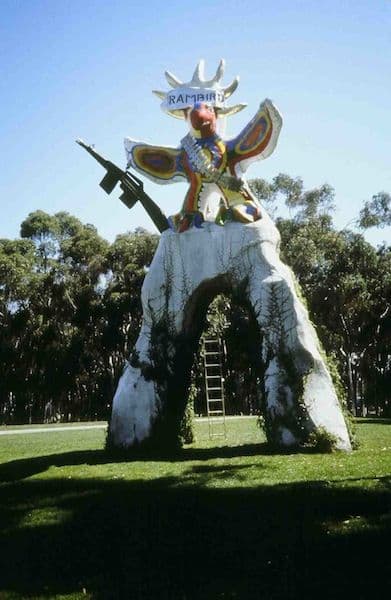
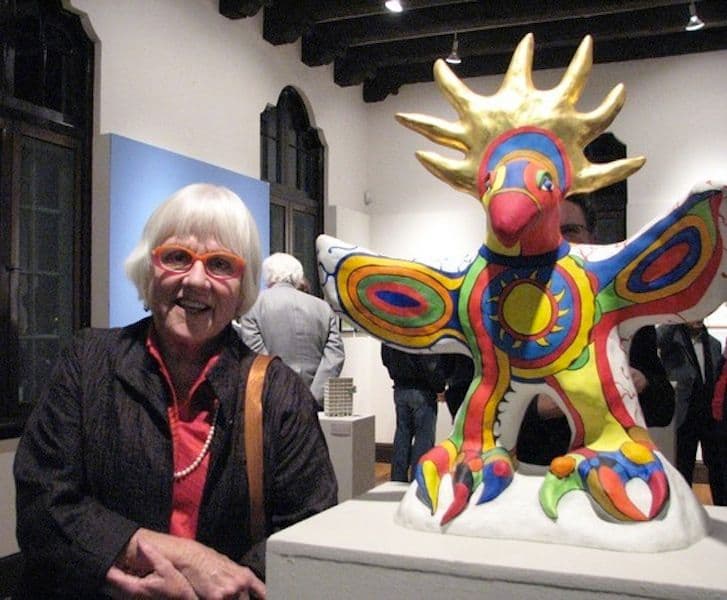
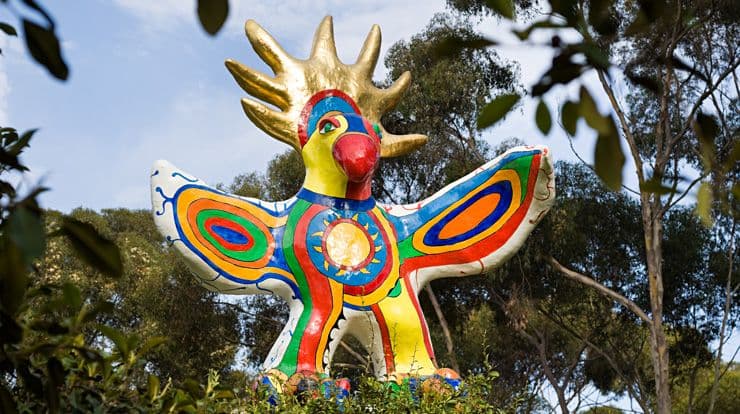
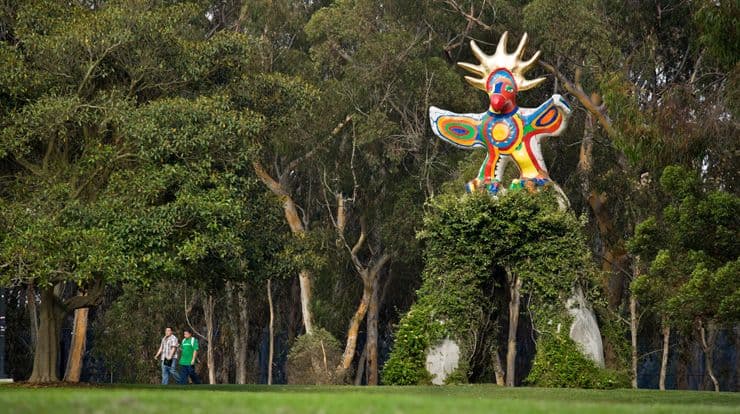
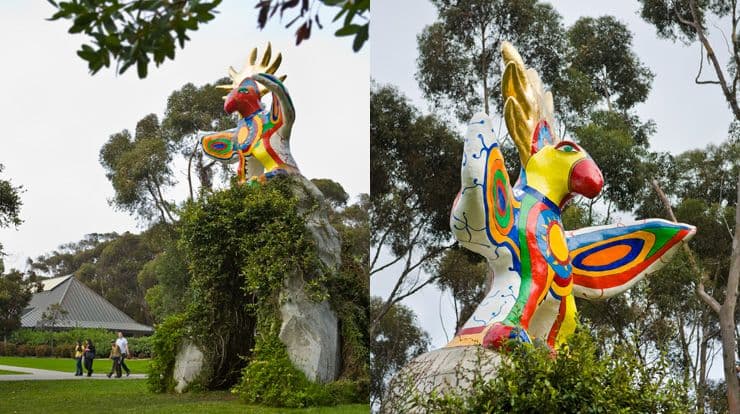
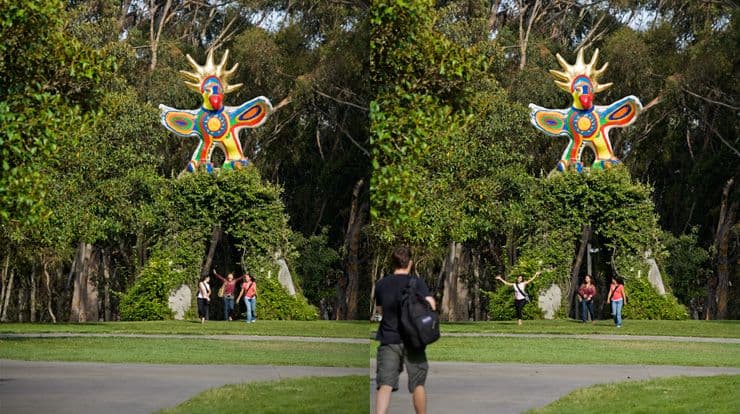
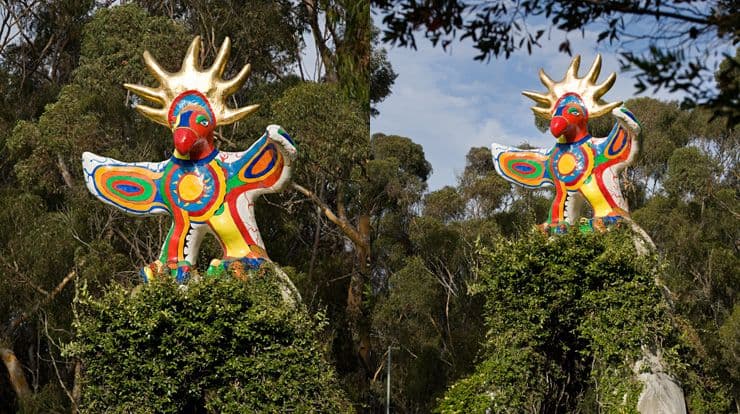
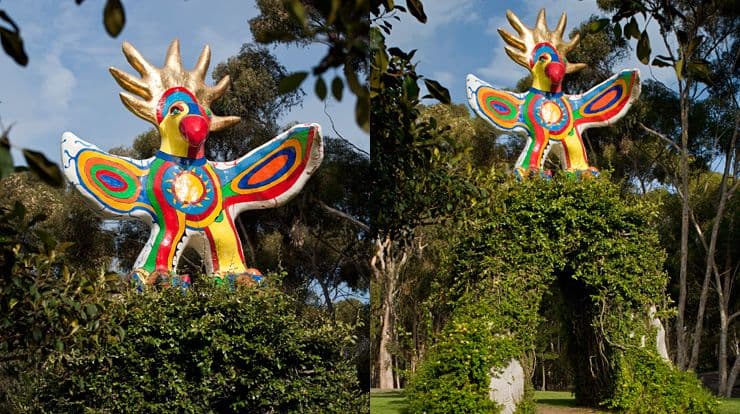
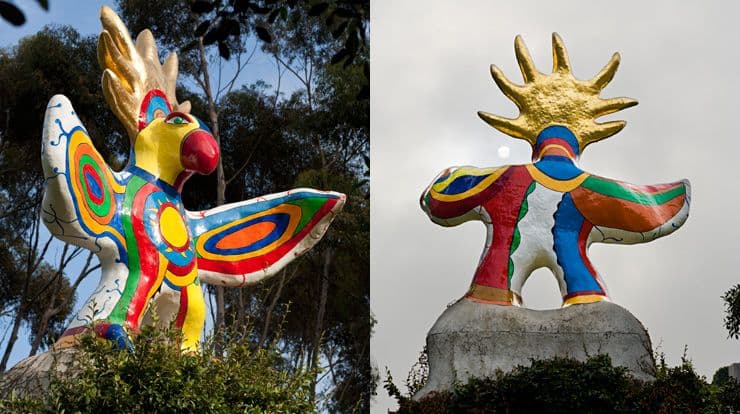
De Saint Phalle's Sun God was the first work commissioned by the Stuart Collection and was her first outdoor commission in America. The exuberantly colored, fourteen-foot bird is placed atop a fifteen-foot concrete arch and sited on a grassy area between the Faculty Club and Mandeville Auditorium. The students started the Sun God Festival in 1984. It has become one of the largest annual campus events.
Essay
Niki de Saint Phalle, Sun God, 1983
When I arrived in San Diego, the agreement between the Stuart Foundation and the Regents of the University of California had not been completely defined, but the advisory board had invited Niki de Saint Phalle and Jean Tinguely—who had collaborated frequently—to make proposals. When they visited the campus together, in 1981, Tinguely wanted to create a fountain. Concerned about droughts and the long-term cost of maintenance, the university was not predisposed to encourage this idea, and after considerable deliberation the Stuart Collection board chose Niki to make the first work on campus.
Niki was best known at the time for her "Nana" works, large, colorful female figures that played on ancient traditions of feminine deities while celebrating feminism's revaluation of the bodies of women. Whatever she might do was likely to elicit both delight and outrage, and she would surely bring a burst of color to the gray concrete of the campus, something in opposition to the solemn monumentality of traditional public art. It would also be Niki's first major outdoor work in America.
Niki was born in France but grew up in both Europe and the United States. She discovered art while young, and found it a salvation for her psyche. She has described working as a "fruitful trauma." By the early 1960s she was achieving respect and notoriety for her "shooting paintings," the products of public events that she orchestrated: having made a kind of collage with bags of paint embedded in it, she would shoot at it with a gun, making the paint splatter and drip. Niki became known as a member of the Nouveau Réalistes, a group of artists including Jean Tinguely, Pierre Restany, Arman, César, and Christo, among others. Niki also soon gained the attention and friendship of American artists Allan Kaprow, Robert Rauschenberg, Ed Kienholz, Merce Cunningham, and John Cage, whose interest in spontaneity and chance she shared.
Niki's influences include Matisse and Picasso, Klee and Henri Rousseau, ancient and so-called primitive art, fairy tales and gargoyles, magic realism, carnivals, folk art, and the architecture of Antoni Gaudí. The force of her personality is clear in her sculpture, which has an irrepressible humor and innocence in tension with an underlying seriousness. Conquering fear with humor is a recurring theme.
Niki proposed three possibilities for the Stuart Collection: a *Life Saviour*, a *Nana House*, and *Sun God*. The latter was her preference, and eventually the board's as well. Niki saw this giant colorful bird with outstretched wings as "an homage to the Southwest." She sent a maquette for the board's consideration and the project was set in motion.
Niki returned to the campus in the fall of 1981, choosing a lawn area near the Mandeville Center as the site. Her original arched base was to be constructed in concrete on site at UC San Diego. The fiberglass bird itself would be made in France, at the studio of Robert Haligon, longtime fabricator of Niki's large-scale works. Meanwhile, in collaboration with the Mandeville Gallery (now the University Art Gallery), we planned an exhibition, *Niki de Saint Phalle: Monumental Projects*, to run in October–November 1981.
There were many reasons to go to Europe in the summer of 1982, and seeing the progress on *Sun God* was high on the list. A small group including Jim and Marne deSilva traveled to the French countryside to Haligon's studios, Niki's fiberglass "foundry," not far from her house in Soisy-sur-Ecole. The Haligon family has been fabricating sculpture for artists going back to Rodin. Here we saw the giant pattern for *Sun God*. The production process, involving a mechanical pantograph, was fascinating, and Mathieu Gregoire, whose first language was French, became involved in order to coordinate the process and build the pedestal archway in San Diego. We went to Niki's house and then, with her, to Jean Tinguely's, where Pontus Hulten and Pierre Restany joined us for dinner. In the twilight we journeyed out to a nearby wood to see a giant outdoor sculpture that Tinguely, Niki, and other artists had been working on sporadically since 1969. This was *Le Cyclop*, an eighty-foot-high mechanized "head"—a composite assemblage of industrial by-products, furniture, and even a real boxcar cantilevered out from the back of the "skull." With some ado, Tinguely and his assistants started the generator. The head groaned into action: chairs went up and down, couches back and forth, "eyeballs" rolled out of "sockets" and down a giant trough, and were taken back up to repeat their descent. Inside there were living and cooking facilities, and a small theatre where all the audience seats were in motion. At the top was an algae-covered pool that Tinguely said was an homage to Yves Klein, and the boxcar turned out to be one of the cars used in the Holocaust deportations, filled with nightmarish sculptural images by Niki. Later Pontus Hulten suggested that the Stuart Collection buy this extraordinary construction, but it was obviously at home in the forest.
By fall we were getting ready to begin building the pedestal on campus. Niki, still back in France, hadn't determined the exact and final siting, and her schedule and her health weren't going to permit a visit for some time. During this time she also revised the arch, in collaboration with Jean Tinguely, into a taller and more dramatic structure. We were eager to proceed with the work, so Niki suggested we go ahead and fix the location. When Mathieu went out to do this, he saw a young couple was lingering in the general area, and the woman had a large parrot on her shoulder. *Sun God*, a birdlike creature, was to be in bright parrot colors. They sat down, and the woman took the parrot off her shoulder and set it on the ground. Mathieu marked the exact spot, and the site was fixed. This really happened.
The form was accurately scaled up from the 1:5 scale model using steel, wire mesh, and air-entrained concrete, a process called gunite. The bird itself would not arrive for several months, and the finished arch alone was a strange sight, which produced mysterious rumors throughout the campus.
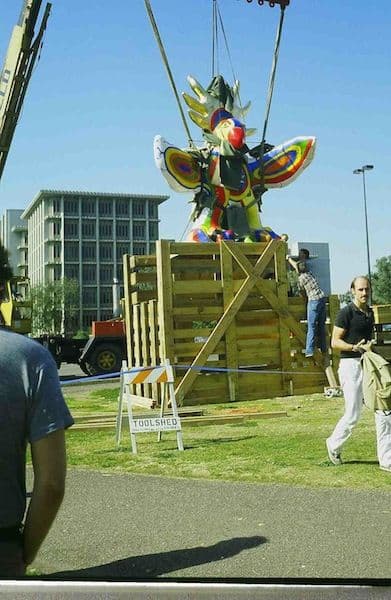
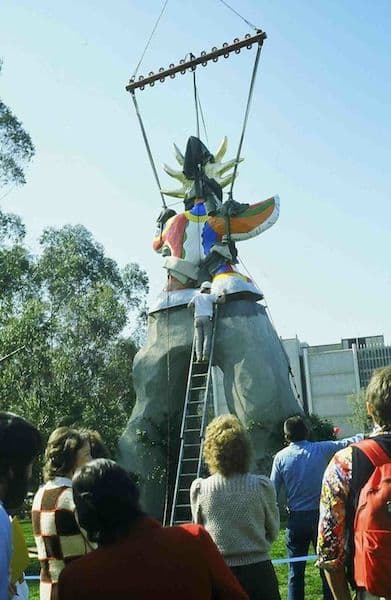
The bird was shipped from France in a slatted crate, arriving in the port of Long Beach in late January 1983. After customs clearance it was put on a flatbed truck and driven down the freeway, sideways, visible through the slats—another strange sight. We had arranged a celebration for the joining of the bird with the arch. People flocked to the site. A crane lifted *Sun God*, wrapped in packing garb, and "flew" it to the base. It was cemented in and the Stuart Collection really had begun: our bird was here to stay.
This zany object was met with a mixture of delight, dismay, and distress. There had been pessimistic forecasts from some about the physical fate of sculpture on campus, so I was very nervous about *Sun God's* well-being on its first night. I slept fitfully, and hurried to school early in the morning to make sure all was well. The bird was still there, and I saw no graffiti, but on the ground at the base there was something strange—a very large handmade paper egg. The unknown artists had written greetings: "Happy Birthday," and, since this was an egg, "Happy Easter." A mascot was born.
Less than a year later, the Associated Students of UCSD, the undergraduate student government, began the process of organizing a Sun God Festival, their first such activity, which has become an annual event that celebrates the end of classes and offers an excuse for revelry before the start of exams. Attendance estimates now top 40,000 joyful students.
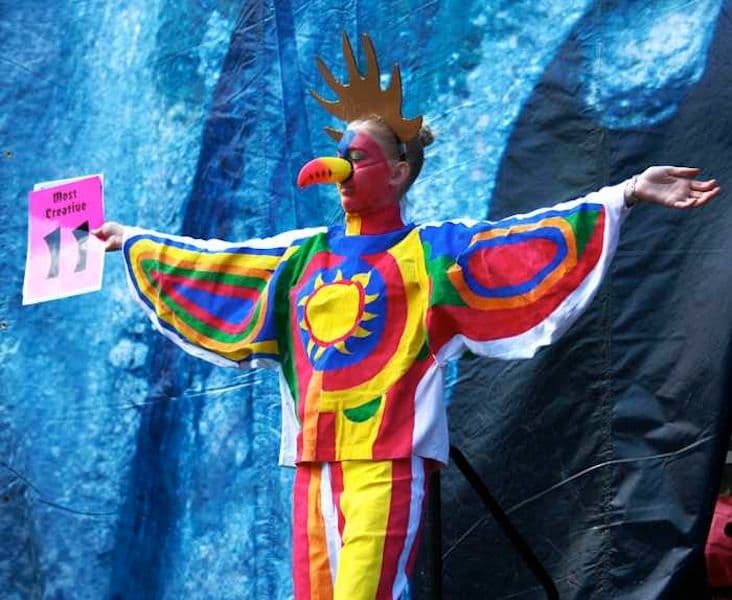
Right away *Sun God* became a landmark, a place where people arrange to meet or leave notes for one another. It has never been damaged, but is often the target of fun: it has worn a cap and gown for graduation; cardboard sunglasses; earphones and a box hanging from one wing saying "Sony Walkbird"; and a bandolier, a machete, and a headband saying "Rambird."
*Sun God* can be interpreted as a phoenix raised from an ancient civilization, an enlightened presence, or an advertisement for the toys on sale at the Tijuana/San Diego border. Its gender has been widely debated. Once, a large straw nest appeared at its base, filled with chicks made from found wrappers, wires, and other cast-off junk, making the bird a mother. On another occasion this great figure became distinctly male, donning a huge yellow penis with testicles in the form of two orange basketballs. A newspaper reporter called to ask if we were waiting for help from the School of Medicine to take this new appendage down. I asked if he was going to publish a picture of it: "Oh no, we're a family paper."
In 1989, on a more somber note, a graduate class made a giant black shroud to "take away" the bird on that year's Day without Art, the annual commemoration of the devastating losses to the creative community from AIDS. The effect was stark and powerful. Clearly *Sun God* made its way almost immediately into the life and traditions of the campus, and remains a participating citizen. In the memories of graduates and visitors, it is a standout. A number of alumni have reported that whether or not they paid much attention to the Stuart Collection when they were students, they carry the images with them, and when they've encountered Niki's work in particular elsewhere (such as the Stravinsky Fountain, her collaboration with Tinguely in Paris), they feel a great sense of recognition, pride, and ownership.
*Sun God* incorporates many opposing forces, and so, true to form, its audacity belies its fragility. The color is vulnerable to the ultraviolet rays in sunlight, and the surface has undergone conservation to restore the original brilliance of the palette. The sculpture has twice been sanded back to pure white before the reapplication of resin. The crown is covered in gold leaf, which lasts much longer than pigment. It is in many ways a living creature, which despite its traditional presentation as sculpture-on-a-pedestal has, because of its integration into the life of the university, become one of the most site-specific projects in the Stuart Collection.
Folklore
Sun God has become a landmark on the UCSD campus. Students have at various times embellished the statue with giant sunglasses, a cap and gown, a UCSD ID card, and a nest of hay with eggs. Sun God has also been adorned with earphones and radio/tapeplayer, turning the statue into a "Sony Walkbird," and has sported a machete and headband for its disguise as "Rambird." It appears on T-shirts and mugs. UCSD art students have made a shroud which covered the bird for the international "Day without Art," in memory of those who have died of AIDS. An annual springtime Sun God Festival has emerged as the largest event sponsored by the UCSD Associated Students. The grassy area beneath it is a popular site for rendezvous and celebrations. There have been countless spontaneous responses which embrace the ***Sun God*** as a campus character.
Share