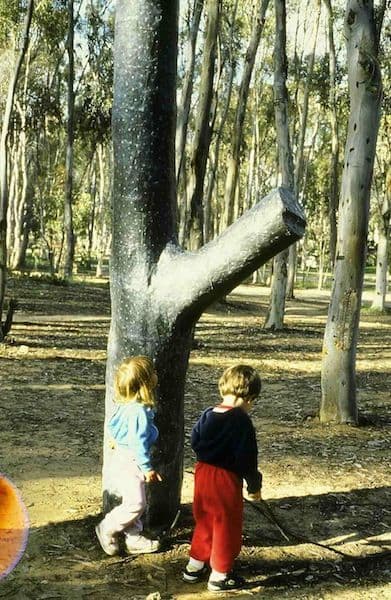
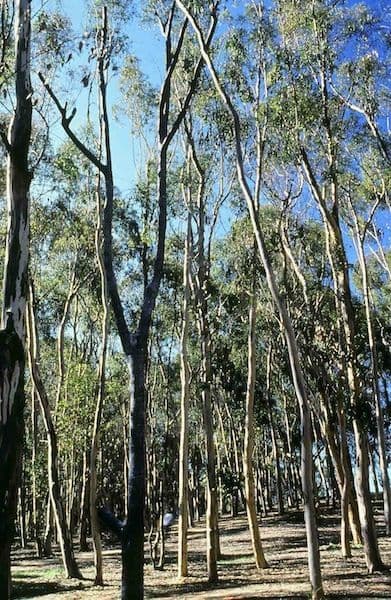
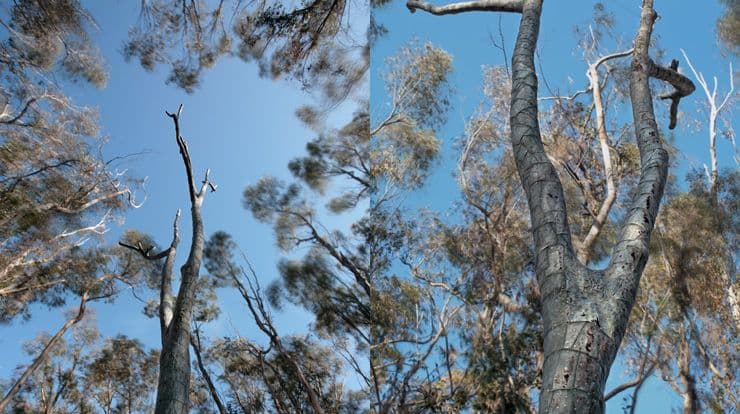
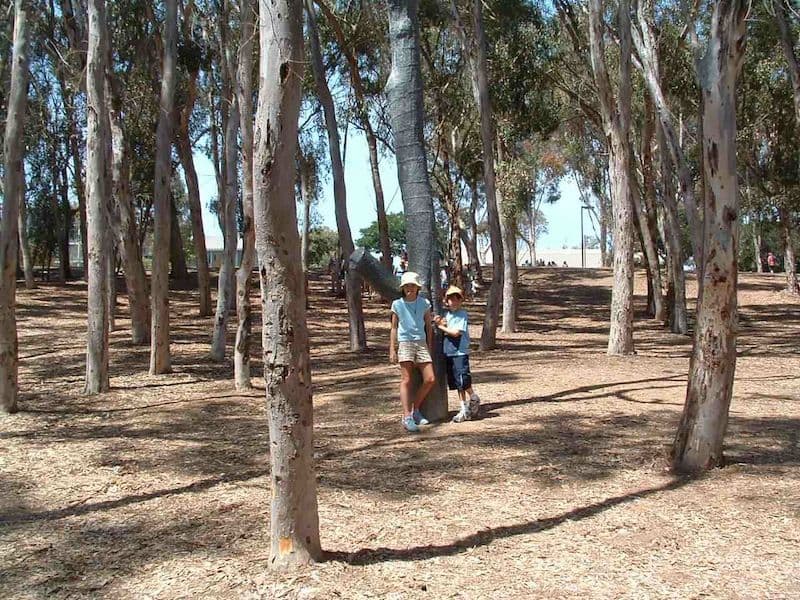
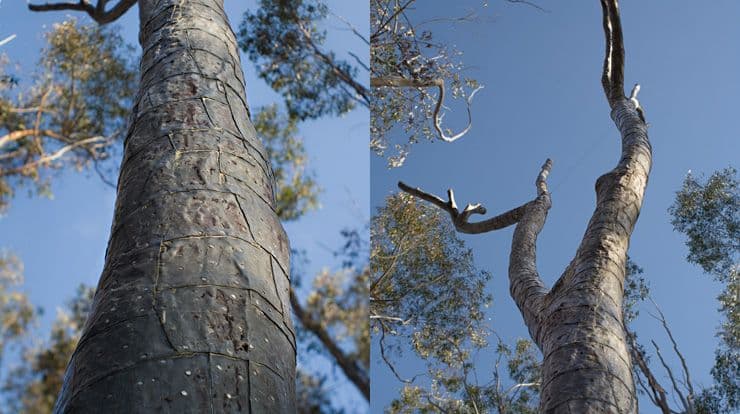
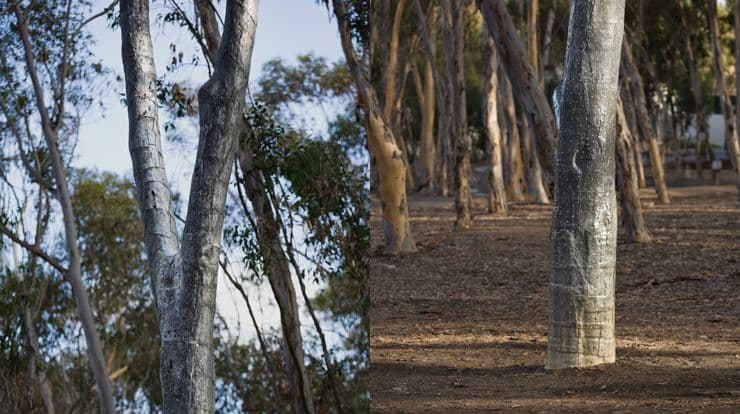
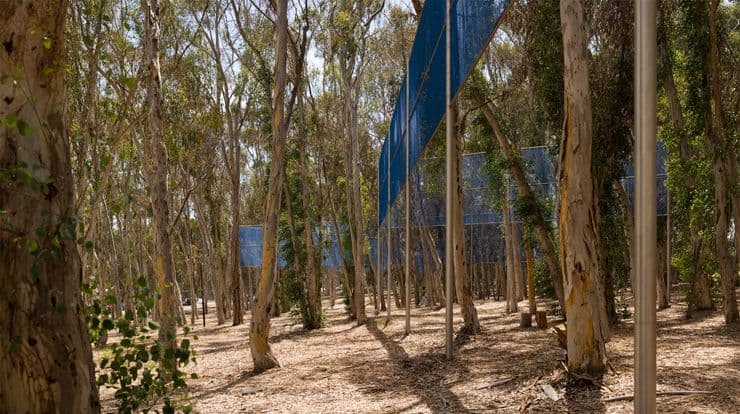
Allen's diverse talents and experiences are highlighted in his first outdoor project, Trees, for the Stuart Collection. He remarks upon the continual loss of natural environment at UCSD by salvaging three eucalyptus trees from a grove razed to make way for new campus buildings. Two of these trees, preserved and encased in skins of lead, stand like ghosts within a eucalyptus grove between the Geisel Library and the Faculty Club. Although they ostensibly represent displacement or loss, these trees offer a kind of compensation: one emits a series of recorded songs and the other a lively sequence of poems and stories created and arranged specifically for this project.
For the music tree, William T. Wiley, known for his paintings filled with literary puns and eccentric maps, sings *Ghost Riders in the Sky*, accompanying himself on a homemade instrument; West Texas singer Joe Ely sings *Mona Lisa Squeeze My Guitar*, while the Maines Brothers work pedal steel guitars, a Thai band plays, and filmmaker/musician David Byrne sings a song he composed especially for this project. For the literary tree, Bale Allen delivers his poem about scabs, the poet Philip Levine recites, plus there are Navajo chants, translations of Aztec poems, duck calls, and many other sound works. *Trees* is a continuous project and Allen and others are at work on future contributions.
One could walk through the grove several times before noticing Allen's two unobtrusive trees. Not only do these trees reinvest a natural site with a literal sense of magic but they implicitly make connections between nature and death and the life of the spirit. It is not surprising that students have dubbed this area the "Enchanted Forest."
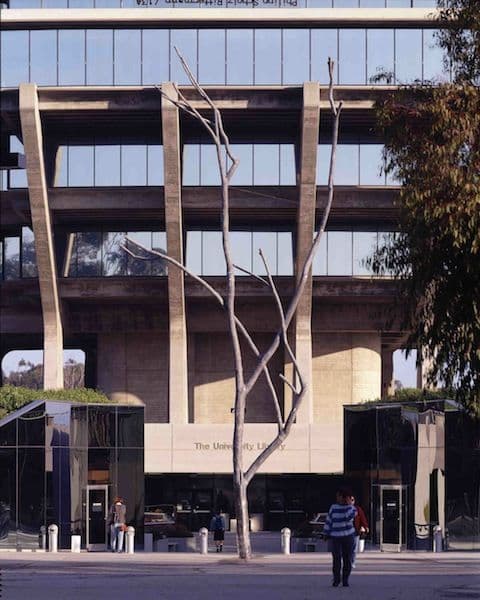
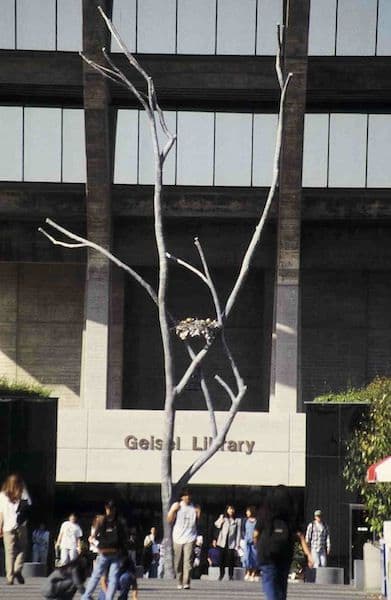
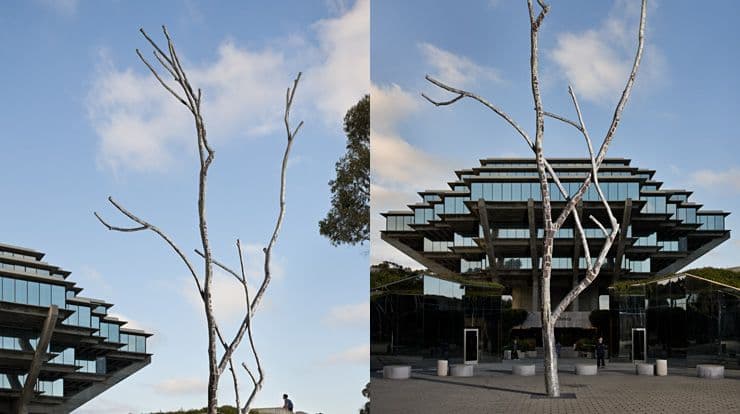
At the entrance to the Geisel library the third tree of Allen's installation remains silent - perhaps another form of the tree of knowledge, perhaps a reminder that trees must be cut down to print books, perhaps a dance form, or perhaps noting that one can acquire knowledge both through observation of nature and through research.
Essay
Terry Allen,Trees, 1986
Terry Allen grew up in Lubbock, Texas, to become a multidisciplinary artist in the truest sense of the term. He paints. He draws. He sculpts and makes installations. He plays the piano, and occasionally other instruments. He composes music and writes lyrics. He sings as the lead vocalist with his own Panhandle Mystery Band. He has explored American value systems through a variety of means, ranging from mass-culture heroes, to fairy tale protagonists, to the ethos of roadhouses in the American Southwest. He is a dramatic storyteller and pithy aphorist in all these mediums.
When he first visited in April 1983, Terry kept insisting he wasn't interested in public sculpture and didn't feel comfortable in a university setting. "Outdoor art is for the birds, Mary. When I go outside I don't want to look at art, I want to look at nature." With some cajoling he returned to the campus late 1983, and just before leaving on a trip to Thailand he sent a long letter outlining several ideas: a large hollow metal heart with interior speakers; a partly buried car, again with speakers, to be used as a getaway place; and trees placed in a grove, also with concealed speakers that would play music and poetry. The trees seemed perfect.
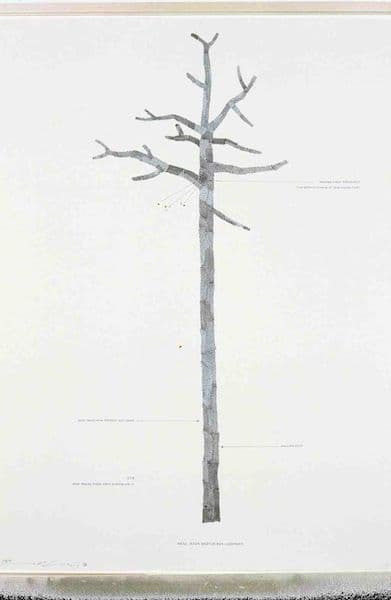
There would eventually be three trees, two of which had speakers and "talked." The third was to be silent. Terry was using sheet lead extensively in his work and decided that the trees would be covered with it, a kind of protective skin that would be similar in color to the subtle and faintly iridescent dove-gray bark of the live eucalyptus throughout the campus. We developed the proposal and a budget, which were approved by the Stuart Collection Advisory Board. The university in turn approved sites next to the library and in the adjacent eucalyptus grove on the condition that the sound would not be too loud and that the trees could be relocated if necessary, in the event of new construction.
As it happened, the university was preparing to erect several buildings at the time, and had to clear a eucalyptus grove. Mathieu Gregoire went out with a local crane company to select and carefully dismantle three trees, each around fifty feet high. On several return trips to campus, Terry decided that the two sound trees—one music, the other poetry—should be "planted" in the large grove south of the library, in places where real eucalyptus had once stood. Here, he felt, the work would summon thoughts both of displacement and loss, and of new life. Wanting to associate the silent tree with the library, he found a site for it near the entrance. The university librarian approved heartily but pleaded, "Couldn't our tree say something too?" to which Terry replied that perhaps it could say "Ssshhh" to people entering the building. The library tree remained silent.
We worked with a structural engineer and a wood preservation company to find ways that these smooth, spindly, elegant trees could be made to stand firm and to "speak" while retaining their structural integrity over time.
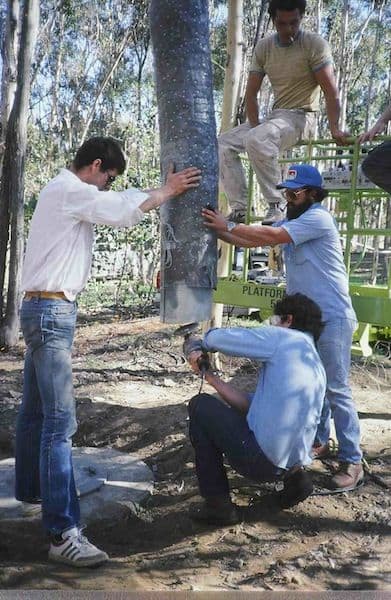
The engineering was tested and the contract was signed, after a copyright agreement for the audio material had been approved by all parties. Speakers were designed to fit within the trees, which were dismantled for pressure treatment to preserve the wood, and then reassembled with metal fittings fabricated at the Scripps Institution of Oceanography Nimitz Marine Facility in Point Loma. Terry and a crew of graduate students went to work nailing squares of sheet lead, while twelve-foot-deep footings were cored. The first tree, which recites poetry and stories, was craned in and installed in January 1986. A week later the second tree, which "sings," magically appeared.
Although these trees can be thought of as representing displacement or loss, they are very much alive: one emits a series of recorded songs and the other a lively sequence of poems and stories. All of the sound works were created and arranged specifically for this project. Terry solicited material from friends, relatives, and artists he admired, and the result is a vast range of music, stories, and poems. For the music tree, William T. Wiley sings "Ghost Riders in the Sky"; West Texas singer Joe Ely sings "Mona Lisa Won't You Squeeze My Guitar"; the Maines Brothers work pedal-steel guitars; a Thai band plays an eerie and beautiful composition; and the musician David Byrne sings a piece he composed especially for the project. For the literary tree, Bale Allen delivers his poem about scabs; the poet Philip Levine recites; plus there are Navajo chants, translations of Aztec poems, duck calls, sounds of jet engines passing overhead, and many other contributions. This is a truly participatory and collaborative project. Over the years songs and stories have been added to the trees, and Terry and others continue to work on future selections.
There are periods of silence between the songs and poems—pauses of up to five minutes on the music tree and longer on the poetry tree. As a result, people just passing by can be truly surprised when a tree starts to talk, or, if they are especially observant, equally surprised when they come upon a silent tree covered in lead. The trees meet the ground just like the live trees around them and the lead both absorbs and reflects the light and the surrounding color. A person could walk right by one of Terry's trees without noticing it among the live trees in the grove, or be right next to it before being startled by its subtle difference. The mysterious lead tree skin beckons: it is soft—and often warm—to the touch. Or one might hear the sounds before realizing their source.
A participatory aspect of Terry's trees is that students and others are welcome to scratch their initials into the lead bark, incising a shiny sliver mark in the surface of the lead—that is, until the scratch oxidizes and returns to its patina. Then others can make their own marks over existing initials, forming layers of "history," seen and unseen, none lasting forever.
In 1988, plans for expanding the library became real. Many considered the original 1972 William Pereira building the centerpiece and icon for the campus, so the expansion and all matters related to it were sensitive subjects. At the same time, the removal of eucalyptus groves for nearby building construction had already been controversial; support for trees was increasing, but not for dead ones. We were entering delicate territory. The silent tree near the library was moved into storage during the expansion, and in 1992 Terry returned to determine the site. The new library entrance was in mirrored glass and concrete, and Terry proposed that the tree be "replanted" right in the middle of this "denatured" site, rather than being disguised somewhere else.
Given the proposed relocation, Mary tried to tell critics how inspiring the tree could be in this new site. The library behind it could invoke different thoughts: a tree of knowledge, or the presence of nature in relation to geometric form, or a sense of silence. The extended branches could be seen to invoke dance, and indeed Terry's placement had the limbs reversed in relation to the sweep of all the nearby trees, which leaned east because of the prevailing western winds. The librarian was persuaded, but others declared the project an "ugly dead tree." Mary suggested that ugliness, like beauty, is in the eye of the beholder, and that although some people might find the tree ugly, others certainly would not: "I acknowledged that the tree was indeed dead, but said that there are many ways to describe things, and that perhaps a university's job was to expand those definitions. Ask people to your house for roast chicken or Thanksgiving turkey, for example, and you'll get an entirely different response than if you invite them for dead bird." The dean of arts and humanities, in good humor, threw up his hands and said that he could think of no reasonable objection and felt that they could no longer oppose the idea. The tree was reinstalled in June 1993. A thick lead square was inlaid at the base of the silent tree to serve as a flush plinth, integrating the cement ground plane with the tree and serving as the label. Along with the title, Terry embossed the names of everyone who contributed to or worked on the trees into the lead of both tree and plinth.
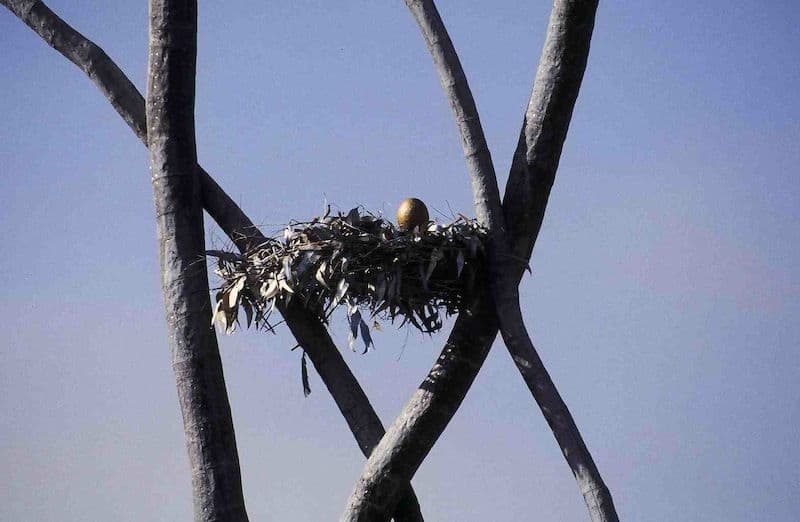
There have occasionally been creative interventions. A large nest has appeared, made of eucalyptus branches with the leaves painted silver, with three golden eggs placed high in the silent tree; and the trees in the grove have "sprouted" baby metal trees.
In 1995, when the construction of Library Walk took place, the area around the silent tree was torn up for some time. When this major campus artery was complete, however, it proved the perfect site: from afar the gray tree is a delicate tracer against the huge form of the library. The eucalyptus groves are not natural; they are in fact planted on a grid, with trees that are not native to the Americas. *Trees* brings to this unnatural site a literal sense of magic. In their speaking and music, and in their silence, they implicitly make connections between nature, death, and the life of the spirit.
Folklore
People have been permitted - even encouraged - to scratch initials into the trees. The letters fade and new ones are scratched on top, creating the effect of the passage of time and people becoming part of the layers and history of the tree.
Share